Soil Health Study
Since the end of 2022, the District has been conducting a soil health study as part of our Ecosystem Health Action Plan (EHAP). The purpose of this study is to identify relationships between urban soils, hydrology, land use, and plant communities. This study also acts as a way for staff to catalogue and identify the make-up of soils within the District A major goal of the study is to use the findings to inform changes to District programs, including:
· Bolstering our existing cost-share program to include soil health and function restoration to protect water resources
· Providing soil health resources for residents, cities, contractors, and other stakeholders
· Updating our regulatory program and rules pertaining to soil impacts
· Identifying long-term impacts of site restoration and maintenance on soil
· Optimizing project site selection and accounting for the benefits of soil function
What is Soil Health?
Oftentimes, people think of soil and dirt as being the same thing. It is what lies beneath your lawn or what you use in your garden to help your plants grow. That's all dirt, right? It is not; it is soil! Soil and dirt are two different concepts. Dirt is a combination of mineral particles that can't sustain life. Soil is an ecosystem containing mineral particles, living organisms, and decayed organisms that sustain plant life. It has biological, chemical and physical characteristics that respond to environmental changes.
Soil health, according to the Natural Resources Conservation Service (NRCS), is the "continued capacity of the soil to function as a vital living ecosystem that sustains plants, animals and humans". Because soil is a living ecosystem, it is critical to preserve or re-establish soil health and function. Healthy, functioning soils are a vital part of broader ecosystems. Functioning soil provides many benefits including:
· Nutrient cycling and retention
· Support of healthy and diverse vegetative communities
· Carbon sequestration
· Greater water infiltration and storage
The Soil Food Web
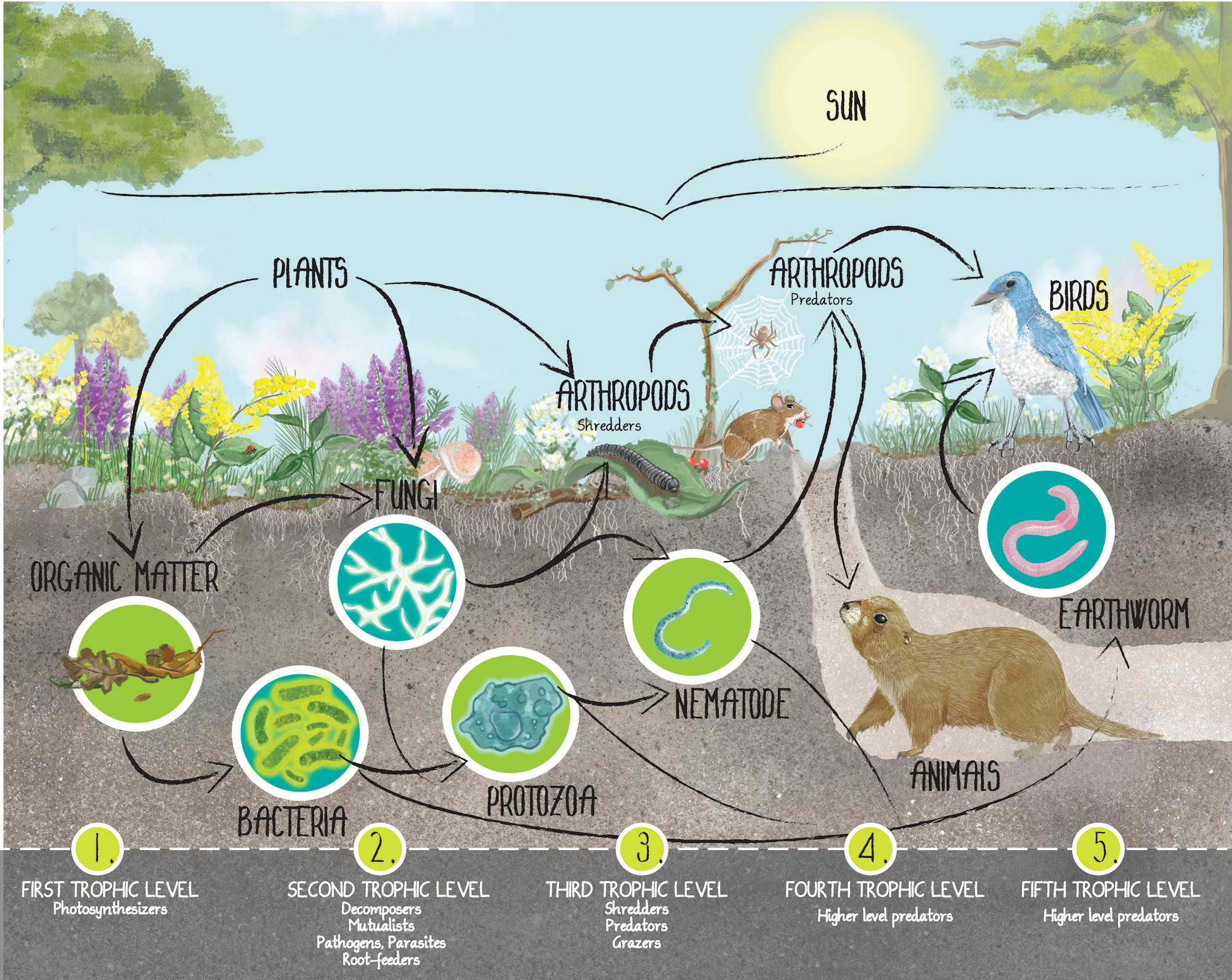
Healthy soils function as an ecosystem. A great way to visualize this ecosystem is through the soil food web. The soil food web is a diverse system of organisms that live all or part of their lives in the soil. When the soil food web functions well, it supports healthy soil. Healthy soils have considerable pore space, or the space between solid particles in the soil. The constant actions of a diversity of organisms at every level in the soil food web create soil pedons, or crumbs, that allow for the creation and maintenance of pore space in soils. Pedons are important for stormwater infiltration and erosion resistance. The space they help create holds water and allows for oxygen exchange with the atmosphere. It is also important for root growth. A well-functioning soil food web also allows soil to hold nutrients, slowly releasing them for plants to use. The food web supports deep plant roots that hold soil in place. These roots leave open channels as they die and decay. These channels allow large volumes of water to readily infiltrate into the soil. Healthy soils support the whole food web, creating a healthier ecosystem.
Key Soil Health Principles
There are four soil health principles that are important for creating healthy soil.
| Minimize disturbance | Soil disturbance can result from physical, chemical or biological activities. It can cause several issues including soil compaction, increase in runoff, increase in soil temperature, disturbance of soil microbes, reduced root mass and a diminished soil food web. |
|---|---|
| Maximize soil cover | Soil cover conserves moisture, reduces temperature, slows and reduces runoff and provides habitat. |
| Maximize biodiversity | Diverse plant communities promotes diversity of microorganisms in soil, thus promoting a healthy soil food web. |
| Maximize presence of living roots | Living roots provide food for soil microbial life, which in turn produce nutrients to be use by plants. |
District Soil Monitoring

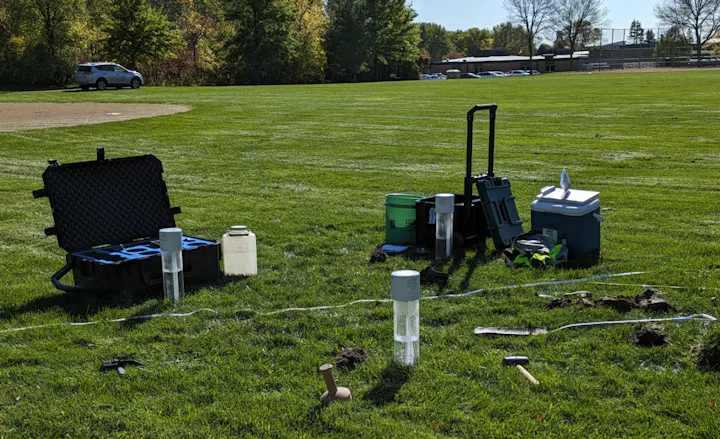
Staff have been conducting soil assessments since 2022. In these assessments, staff are assessing soil functions of representative land use types across our three creek watersheds. Representative land use types are land uses which exist within our District. These land uses vary from more natural landscapes such as restored prairies or woodlands to more developed landscapes such as residential lawns.
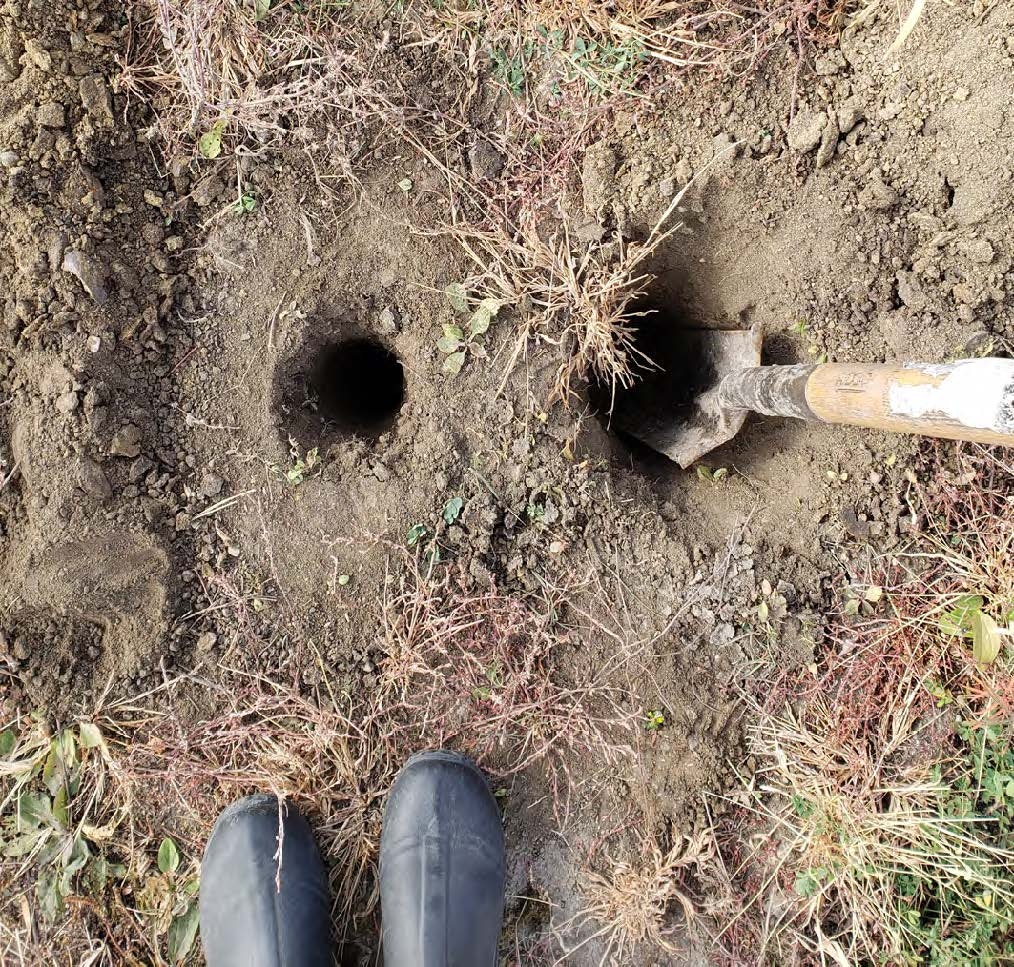
Assessments consist of two main components: infiltration testing and soil sampling. Infiltration testing is conducted using a Modified Philip Dunne (MPD) infiltrometer which automatically measures and records infiltration rates and hydraulic conductivity. Hydraulic conductivity is the infiltration rate of the water once the soil has reached 100% saturation and the infiltration rate has become constant. This data helps identify areas which may have more capacity for capturing and storing stormwater and potentially reducing runoff. Soil sampling consists of collecting several 6" x 6” x 2" sub samples across a site, mixing them together, and removing a composite sample to be analyzed for a series of soil health indicators. Soil sample data helps identify how different land uses compare to one another in terms of soil health indicators. Other information such as bulk density, soil profiles observations, and site vegetation makeup is also collected. Soil samples are sent to the Cornell Soil Health Laboratory for analysis. The table below shows the soil health indicators measured for by Cornell.

Urban Soil Health
Since the District has a predominantly urban landscape, a major source of soil degradation is development, both residential and commercial. Development causes soil mixing, compaction, and it replaces native plants with turf grass. Diverse communities of native plants support infiltration through deep roots and improving the microbial community. Without the presence of these native plant communities, soils degrade over time. Degraded soils have poor soil structure that limits stormwater infiltration which increases runoff. The increase of runoff leads to erosion and the depositing of sediment and nutrients into downstream lakes and streams.
Urban soils are particularly understudied. Many researchers have identified ways soil has degraded in urban environments. Many haven't identified ways to re-establish these degraded soils. Through the soil health study, the District aims to use the data we collect on these degraded soils to identify ways we can re-establish soil health and functions within our watersheds.
Resources
Cornell University Comprehensive Assessment of Soil Health Manual:
Cornell Comprehensive Assessment of Soil Health (CASH) manual.pdfExample Cornell Sample Report:
NLLP-CASH-Report.pdfIntroduction to Soil Health:
Soil Pamphlet (digital view).pdf2024 Soil Health Program Report
2024 Soil Health Program Report.pdf